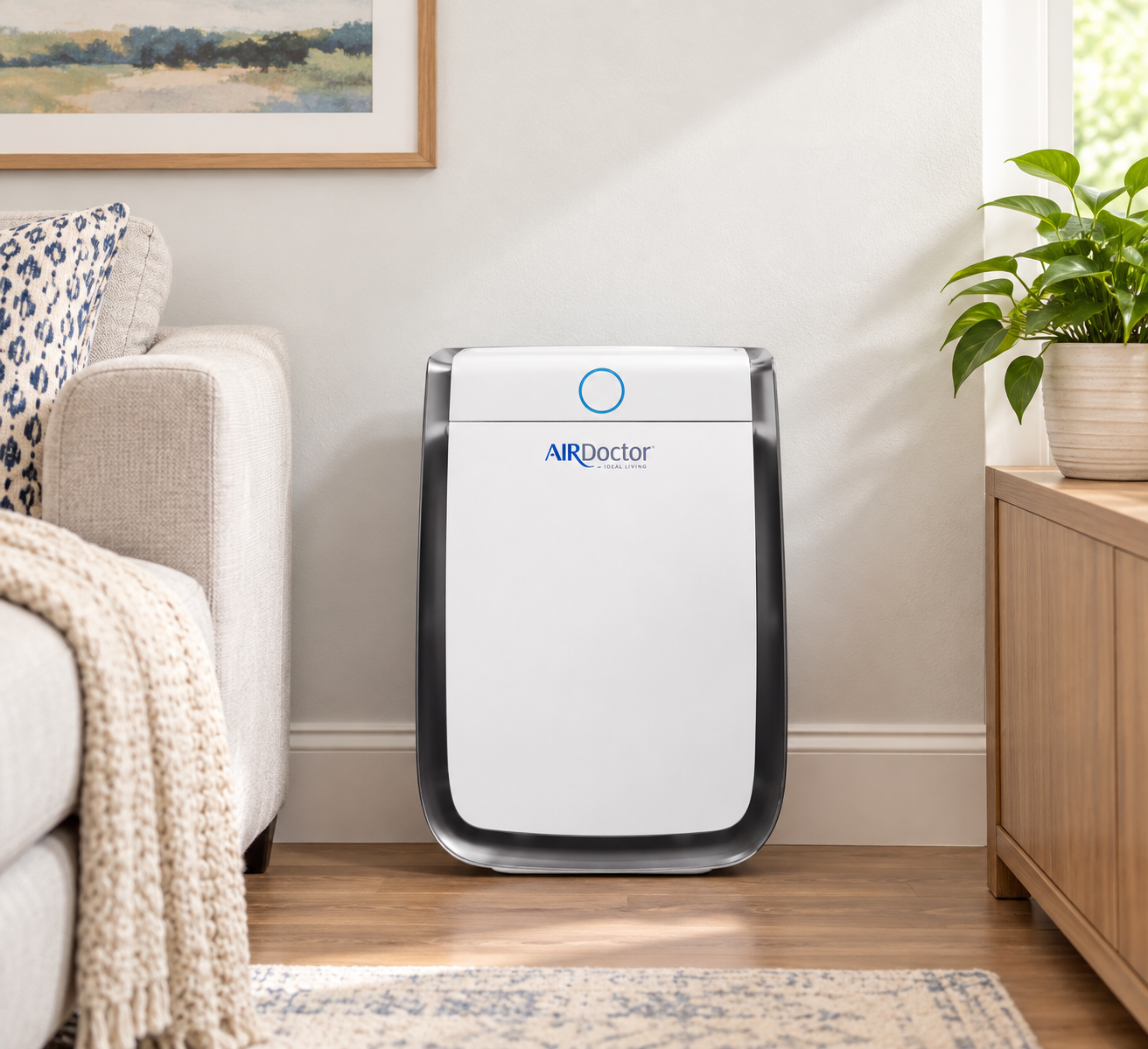
AirDoctor 3500 Review: Is It Worth the Price?
This article contains affiliate links. If you purchase through one of these links, we may earn a commission at no extra cost to you. We only recommend products we believe in based on our own research and testing.
If pet dander, dust, or wildfire smoke keeps drifting through your home, you’ve probably seen an AirDoctor 3500 ad. At $659 on AirDoctor’s own product page, it costs far more than a basic Levoit or Winix unit. That price gap makes it fair to ask if you’re paying for real performance or just polished marketing.
This review covers what the AirDoctor 3500 actually does and what it costs to run over time. It also looks at where past buyers have run into problems. By the end, you’ll know whether it fits your room size, your budget, and your patience for filter maintenance.
Quick Verdict: Who This Is For
- Best for: people with pets, dust sensitivity, or larger rooms who want a well-built purifier and don’t mind a higher upfront cost.
- Skip it if: you’re on a tight budget, only need to cover a small bedroom, or want swappable generic filters.
- Standout strength: a dedicated carbon/VOC stage paired with a HEPA filter rated to capture particles as small as 0.003 microns.
- Biggest downside: ongoing filter costs and real-world coverage that falls short of the brand’s top-end square footage claims.
What Is the AirDoctor 3500?

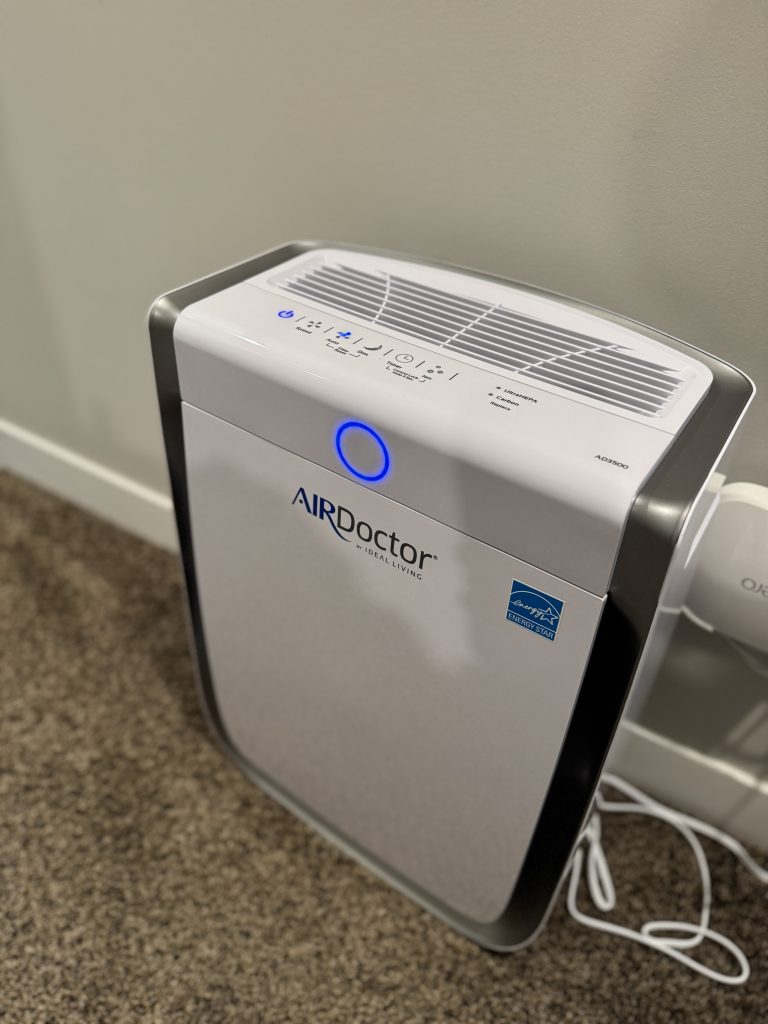
The AirDoctor 3500 is a three-stage air purifier from AirDoctor LLC, part of the Ideal Living family of brands. It’s built for medium to large rooms and uses three filtration stages working together in one unit.
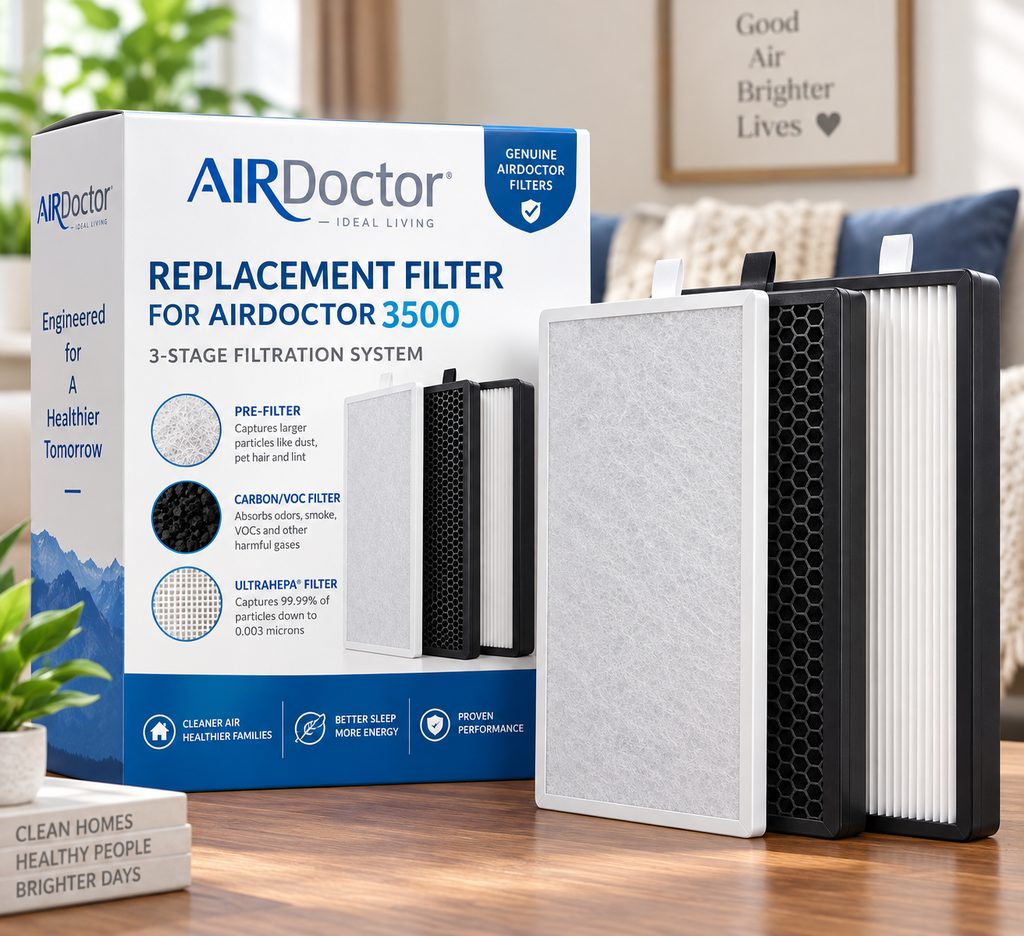
The first stage is a washable pre-filter that catches larger debris like pet hair, dust, and lint. Next comes a carbon and gas-trap filter designed to reduce odors and volatile organic compounds, or VOCs. These are the fumes that come off things like paint and cleaning products.
The final stage is AirDoctor’s UltraHEPA filter. The brand says it’s independently tested to capture 99.99% of airborne particles down to 0.003 microns.
AirDoctor markets the 3500 for rooms up to around 630 square feet. Some listings cite coverage closer to 1,260 square feet at two air changes per hour.
Independent testing measured its clean air delivery rate, or CADR, at 336 cubic feet per minute. Using standard EPA guidance, that number lines up more realistically with a room around 500 square feet. That’s worth knowing before you buy for a large open living area.
Key Features and How It Performs
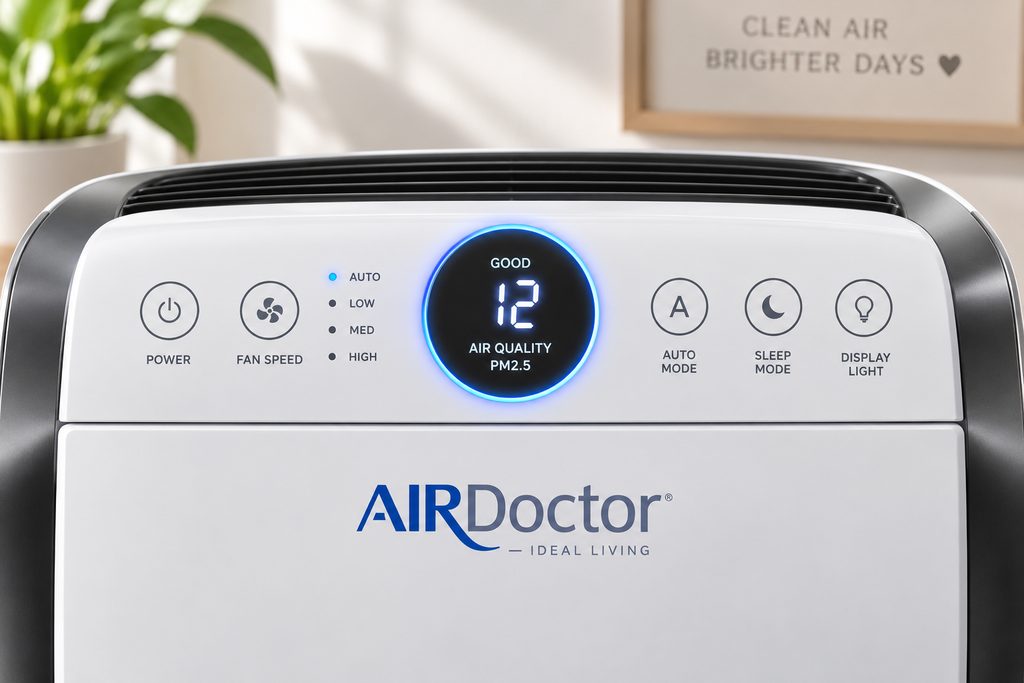
The three-stage design is the main selling point. Some competitors require a separate carbon filter add-on for odor control.
The AirDoctor 3500 bundles pre-filtration, odor control, and particle capture into one machine instead. That makes filter changes simpler, even if it means fewer customization options.
The unit includes an air quality sensor that adjusts fan speed automatically based on what it detects in the room. It also has manual speed settings for when you want more control.
Owners commonly note that higher fan speeds move more air but also produce more noise. That matters if you plan to run it in a bedroom overnight.
A small number of Amazon reviewers reported a plastic or off-gassing smell when first turning on the unit. Reviewers who cover this call it a documented but uncommon complaint compared to the overall volume of positive feedback. It typically fades after the first day or two of use.
Pricing and True Cost of Ownership
AirDoctor lists the 3500 at $659 on its official air purifiers page. That places it between the AirDoctor 2000 ($399) and the AirDoctor 4000 ($679).
Some retailers, including Walmart, have listed the non-smart 3500 for less depending on current promotions. It’s worth comparing prices before you buy.
The real cost question is filters. AirDoctor recommends replacing the carbon/VOC filter every six months and the UltraHEPA filter every twelve months.
Long-term owners report annual filter costs landing around $160 when timed well. Buying replacement filters at full retail price can push that above $200 a year. Either way, budget for that ongoing expense on top of the purchase price.
AirDoctor offers financing through Affirm at checkout for buyers who want to split the cost into payments, subject to approval. The company also partners with Truemed, which lets some buyers use HSA or FSA funds toward the purchase. That’s worth checking if you have either account.
See current AirDoctor 3500 pricing

Pros and Cons
- Pro: Three filtration stages, including a dedicated carbon/VOC layer, in one unit.
- Pro: UltraHEPA filter rated to capture particles as small as 0.003 microns.
- Pro: Financing and HSA/FSA payment options available at checkout.
- Con: $659 upfront cost is well above budget purifiers like Levoit or Winix.
- Con: Filters run $160 to $200-plus per year and only work with AirDoctor’s proprietary design.
- Con: Marketed square-footage coverage is higher than what independent CADR testing supports.
- Con: Fan noise increases noticeably at higher speed settings.
What Real Customers Say
AirDoctor’s own site shows a 4.9-star average. Amazon reviews for the brand run around 4.6 stars, based on independent review roundups. Owners frequently mention noticeable dust reduction and easier breathing in rooms where they run the unit consistently.
Complaint patterns show up too, mostly around ongoing costs and support. BBB profiles document disputes where customers were asked to cover return shipping costs during a refund. Some felt that policy wasn’t clearly communicated upfront.
A smaller number of long-term owners report units failing after the one-year warranty window. One owner noted a purifier from AirDoctor’s lineup stopped working after about three years, with no replacement parts available.
These are documented patterns from a portion of buyers, not the typical outcome. Most reviews are positive, but it’s worth going in with realistic expectations about support after the warranty ends.
As of this writing, no recalls, lawsuits, or FTC actions have been filed against AirDoctor specifically. A separate company with a similar-sounding name, Air AI Technologies, settled unrelated FTC charges over business-opportunity marketing in 2026. That case has no connection to this air purifier.
AirDoctor 3500 vs. Alternatives
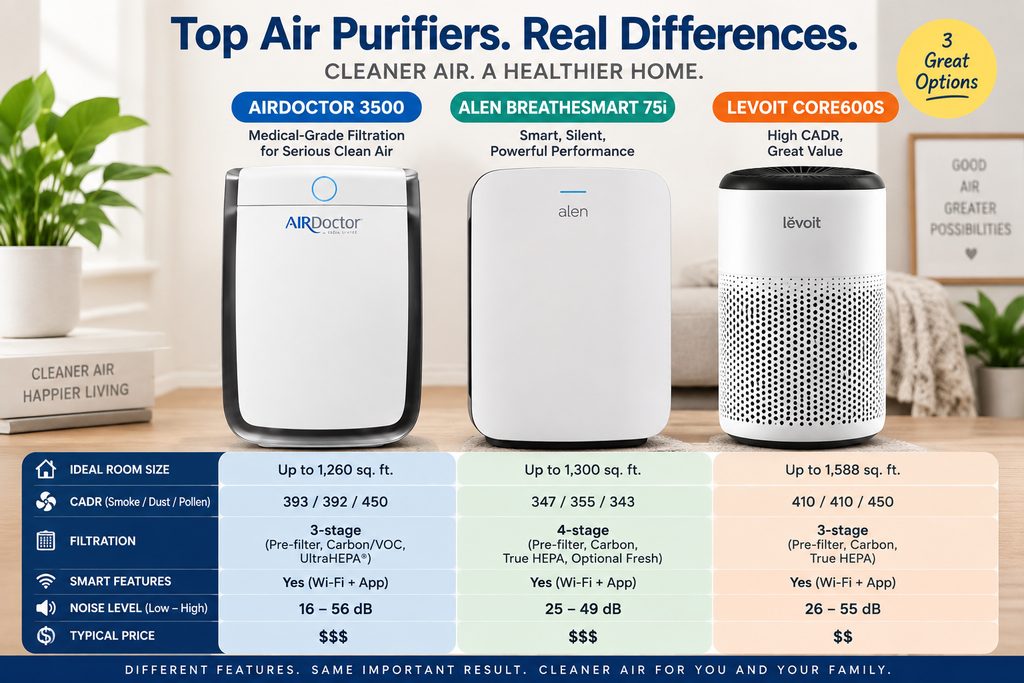
The 3500 sits in a crowded field of premium purifiers. Here’s how it stacks up against three products shoppers commonly compare it to.
| Model | Approx. Price | Key Difference |
|---|---|---|
| AirDoctor 3000 (predecessor) | Lower, when available | Similar filtration performance but cannot use the 3500’s redesigned filters |
| Alen BreatheSmart 75i | Higher | 347 CADR and 1,300 sq ft coverage, backed by a lifetime filter-subscription warranty, but a larger and heavier console |
| Levoit Core600S / EverestAir | Lower | Budget-friendly option with weaker dedicated VOC filtration compared to AirDoctor’s carbon stage |
If you already own an AirDoctor 3000, keep in mind the 3500’s redesigned filter won’t fit your older unit. That matters if you’re deciding whether to upgrade or replace with the same model line.
Compare AirDoctor models on the official site

Warranty, Returns, and Guarantee
AirDoctor backs the 3500 with a one-year limited warranty and a 30-day Breathe-Easy Guarantee. That guarantee lets you try the purifier for 30 days. If you return it, you get a full refund of the purchase price, minus shipping and handling.
The return policy states customers are responsible for return shipping fees. Confirm this on the order page before buying, since it affects your refund amount.
Who Should Buy It, and Who Should Skip It
The AirDoctor 3500 makes sense for households with pets, dust concerns, or a family member sensitive to airborne particles. It works best in a room in the 400 to 500 square foot range. It also suits buyers who value a built-in VOC/odor filter and don’t mind paying more for it.
Skip it if you’re on a tight budget or only need to cover a small bedroom. The same goes if you want the flexibility of swapping in cheaper generic filters down the road. In those cases, a budget option like Levoit may serve you just as well for less money.
For a broader comparison across price tiers, our {internal link 1} guide breaks down options for allergy-focused households. Our {internal link 2} covers picks specifically for pet owners.
Top 5 air purifiers for allergies guide
Air purifier guide for pet owners and allergy sufferers
FAQ
Is the AirDoctor 3500 worth the price compared to cheaper purifiers?
It depends on your priorities. The 3500 offers a dedicated carbon/VOC stage and a fine-particle HEPA filter that budget purifiers often skip. But it costs more upfront and in yearly filter replacement.
How much do AirDoctor 3500 replacement filters cost per year?
Owners report annual filter costs around $160 when timed and purchased carefully. Buying at full retail price can push the total above $200 a year for both filters combined.
What size room does the AirDoctor 3500 actually cover?
AirDoctor markets coverage up to around 630 to 1,260 square feet, depending on air changes per hour. Independent CADR testing supports a more realistic range closer to 500 square feet for typical use.
What’s the difference between the AirDoctor 3500 and the 3500i?
The 3500i adds Wi-Fi connectivity and smart app controls. The standard 3500 is mechanically identical in filtration performance, just without the smart features.
What’s the difference between the AirDoctor 3500 and the older 3000?
Both models offer similar air-cleaning performance. But the 3500 uses a redesigned filter that isn’t interchangeable with the 3000’s older filters. That affects long-term parts sourcing.
What is AirDoctor’s return and warranty policy?
AirDoctor includes a one-year limited warranty and a 30-day Breathe-Easy Guarantee that refunds the purchase price minus shipping. Customers are responsible for return shipping costs.
Is the AirDoctor 3500 noisy on high speed?
Multiple owner reviews note the fan gets noticeably louder at the highest speed settings. That may not suit light sleepers running it in a bedroom overnight.
Can I use HSA or FSA funds to buy an AirDoctor 3500?
Yes, AirDoctor partners with Truemed to let eligible buyers apply HSA or FSA funds toward the purchase, subject to Truemed’s qualification process.
Final Verdict
The AirDoctor 3500 works best for households with pets, dust, or airborne particle concerns. It fits a room in the 400 to 500 square foot range better than a whole open floor plan.
Its biggest strength is the three-stage filtration in one unit. Its biggest limitation is the ongoing filter cost, which can push $160 to $200 or more a year on top of the purchase price.
The evidence supports recommending it to buyers who’ve budgeted for those ongoing costs. It works best when your room size matches its real-world coverage, not its marketing ceiling. If you’re working with a tighter budget or a smaller space, a lower-cost purifier is likely the smarter buy.
Check AirDoctor 3500 availability and offers